What MERV rating air filter do I need?
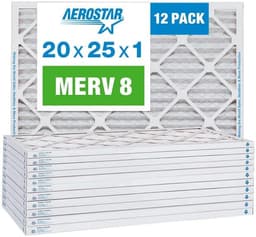
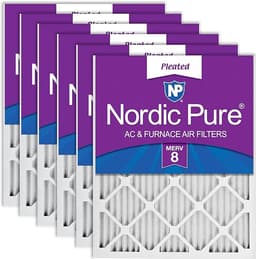
Most homes do best with MERV 8 to MERV 13. MERV 8 for basic protection, MERV 11 if you have pets or mild allergies, MERV 13 for severe allergies, asthma, or smoke. Don't go higher than your HVAC system can handle. Check your manual for the max MERV rating your system supports.
What size air filter do I need?
Check the side of your current filter. The size is printed on the cardboard frame (e.g., 20x25x1). If it's faded, measure your filter slot: length x width x depth in inches, then round up to the nearest whole number. That rounded number is your "nominal size," which is what you order.
What's the most common furnace filter size?
The most common residential filter sizes are 20x20x1, 16x25x1, 16x20x1, and 20x25x1. The "1" is the standard 1-inch depth that fits most HVAC systems. These four sizes cover roughly 60 to 70 percent of homes.
How often should I change my furnace filter?
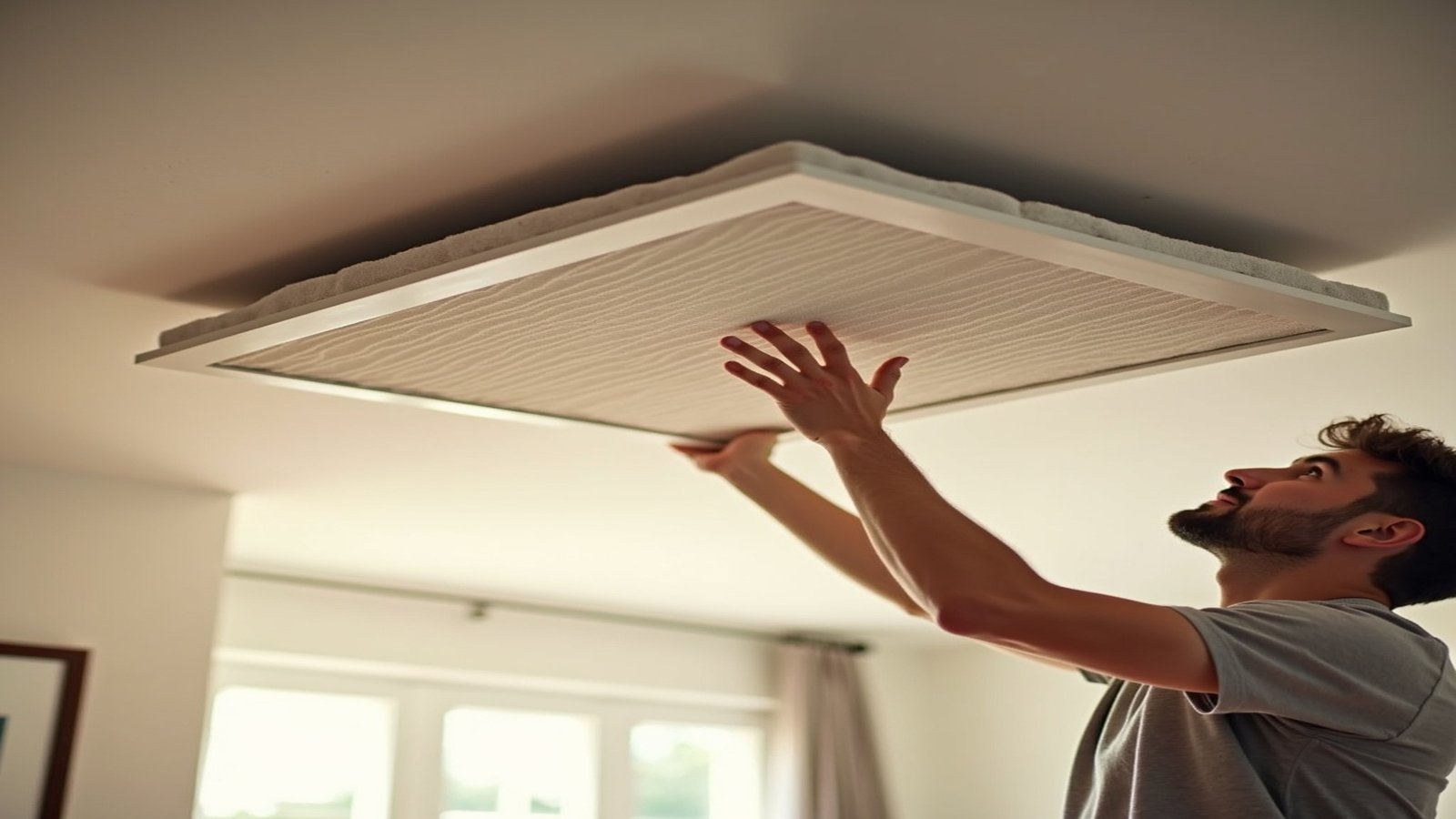
Standard 1-inch filters: every 60 to 90 days. Homes with pets, allergies, or heavy dust: every 30 to 45 days. Deep pleated 4 to 5 inch filters: every 6 to 12 months. A dirty filter makes your HVAC work harder, raises energy bills, and worsens air quality.
What is the difference between MERV 8 and MERV 13?
MERV 8 catches particles 3 microns and larger (dust, pollen, lint). MERV 13 catches particles down to 0.3 microns (smoke, bacteria, virus carriers). Higher MERV means better filtration but more airflow restriction. MERV 13 is the highest rating recommended for residential use.
Is a higher MERV rating always better?
No. Higher MERV means denser filter media, which restricts airflow. If your HVAC system can't handle it, you'll strain the blower motor, increase energy costs, and potentially damage the system. Most residential systems handle MERV 8 through 13 fine. Check your manual for the max MERV rating.
What MERV rating do I need for allergies?
MERV 11 minimum for seasonal allergies (pollen, dust mites, mold spores). MERV 13 for severe allergies or asthma, as it captures finer particles including some bacteria. The EPA recommends MERV 13 or higher for managing airborne allergens.
What MERV rating do I need for pets?
MERV 11 captures pet dander, fur, and dust mites that MERV 8 misses. If you have multiple pets or family members with pet allergies, step up to MERV 13. Replace filters every 30 to 60 days with pets because they clog faster.
What air filter do I need for wildfire smoke?
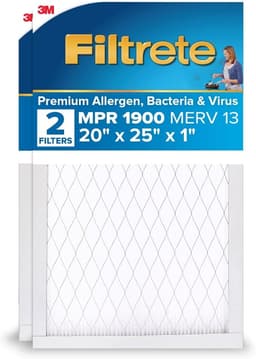
MERV 13 minimum. The EPA specifically recommends MERV 13 or higher for filtering wildfire smoke particles. The Filtrete MPR 1900 (MERV 13) with carbon is a strong choice for combined smoke particle and odor removal.
What's the difference between MERV, MPR, and FPR?
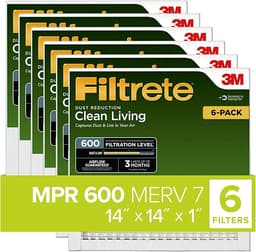
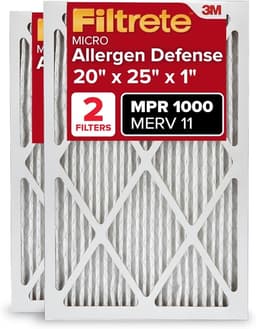
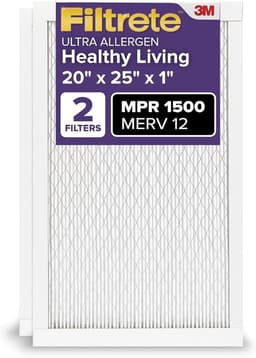
MERV (Minimum Efficiency Reporting Value) is the industry standard, rated 1 to 16. MPR (Microparticle Performance Rating) is 3M/Filtrete's proprietary scale, rated 300 to 2800. FPR (Filter Performance Rating) is Home Depot's scale, rated 4 to 10. Rough equivalents: MERV 8 is about MPR 600 / FPR 5. MERV 11 is about MPR 1000 / FPR 7. MERV 13 is about MPR 1500 to 1900 / FPR 10.
What's the difference between nominal size and actual size?
Nominal size is the rounded number printed on the filter label (e.g., 20x25x1). Actual size is the exact measurement (e.g., 19.5 x 24.5 x 0.75 inches). Always order by nominal size. Filters are designed to be slightly smaller than stated for easy installation into your filter slot.
Can I use a Filtrete filter in a Honeywell system (or vice versa)?
Yes, for standard 1-inch and 2-inch filters. Size and MERV matter, not brand. A 20x25x1 MERV 11 from any manufacturer fits any system with a 20x25x1 slot. For 4 to 5 inch deep-pleated filters, check that the actual dimensions match your specific filter cabinet, as they vary more between brands.
MERV 11 vs MERV 13: which one should I get?
Get MERV 11 if you have pets or mild seasonal allergies. It captures pet dander, dust mites, mold spores, and fine pollen (1 to 3 microns) and runs on virtually any residential HVAC system without straining airflow. Step up to MERV 13 only for severe allergies, asthma, smokers in the home, or wildfire smoke, since it catches finer particles down to 0.3 microns including smoke and bacteria. MERV 13 uses denser media, so confirm your system supports it before installing. For most homes, MERV 11 is the better balance of filtration and airflow.
What MPR filter do I need, and how does MPR compare to MERV?
MPR (Microparticle Performance Rating) is 3M Filtrete's own scale, running 300 to 2800. Match it to your situation: MPR 600 for basic dust and pollen (about MERV 8), MPR 1000 to 1200 for pets and mild allergies (about MERV 11), and MPR 1500 to 1900 for severe allergies, asthma, or smoke (about MERV 12 to 13). A higher MPR means denser media and more airflow restriction, so do not jump to the top of the scale unless your situation and HVAC system call for it.
MERV vs Filtrete: are they the same thing?
No. MERV is the independent industry standard (rated 1 to 16). Filtrete is a 3M brand of filters that uses its own MPR scale instead of printing a MERV number. So the choice is not MERV versus Filtrete, it is which MERV equivalent of a Filtrete filter you need. A Filtrete MPR 1000 is roughly MERV 11; an MPR 1900 is roughly MERV 13. Any brand at the same MERV equivalent and size filters comparably, so compare by MERV or MPR equivalent and price, not by brand name alone.